

Overview
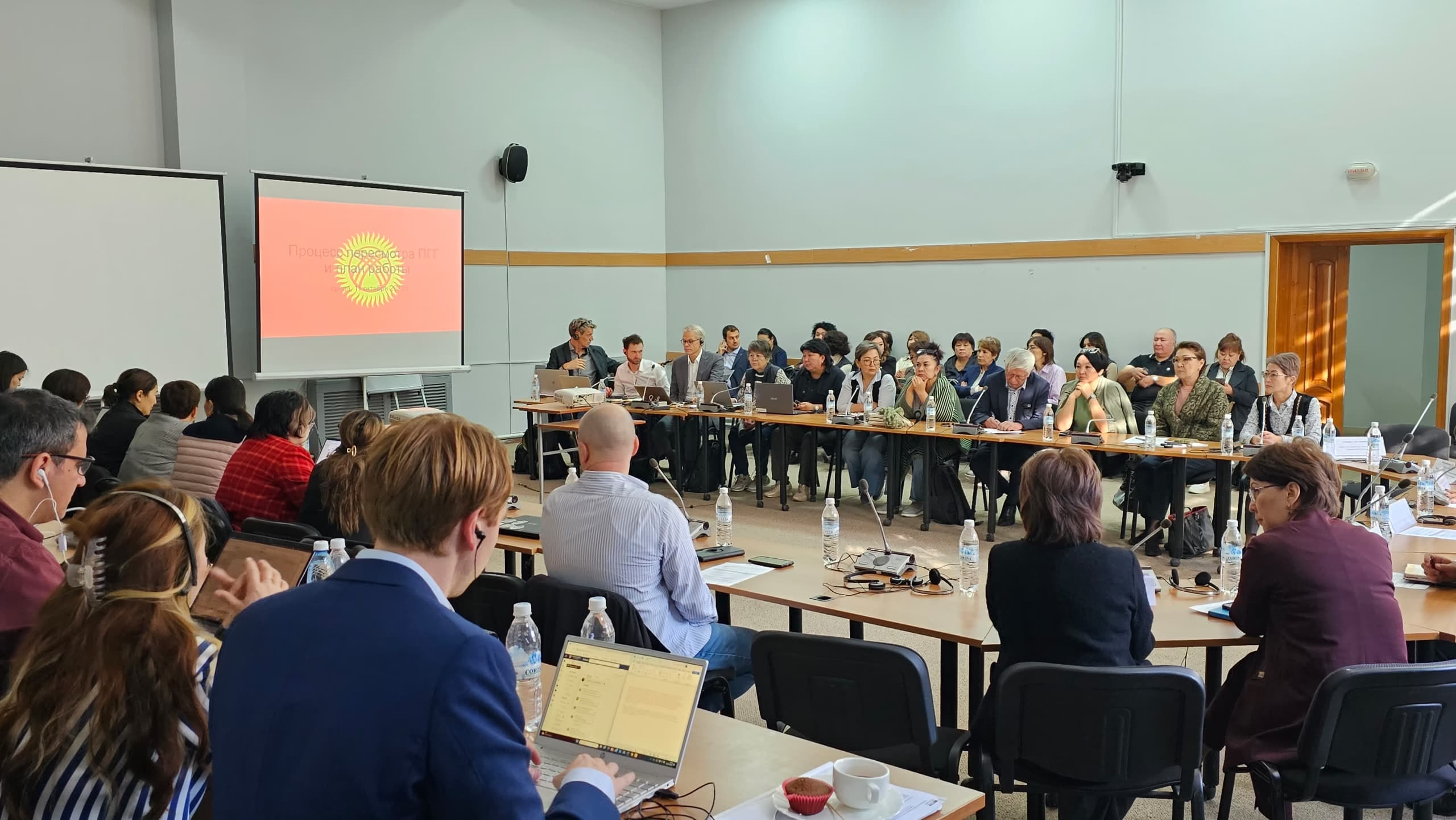
In Kyrgyzstan, Radboudumc and UCL supported a comprehensive revision of the State-Guaranteed Benefits Programme (SGBP) through the application of an Evidence-Informed Deliberative Process (EDP) combined with the WHO Universal Health Coverage Compendium (UHCC). This reform represents the first full system-wide application of the UHCC globally to redesign a national health benefits package.
Working closely with the Ministry of Health and the Mandatory Health Insurance Fund, we helped structure the revision to address long-standing weaknesses in entitlements, fiscal sustainability and alignment between policy commitments and available resources. Through structured governance, service-level costing and explicit prioritisation criteria, the reform resulted in a transparent and implementable benefits package grounded in fiscal reality.
Context & Objectives
Since its introduction in 2001, the SGBP lacked an explicit and standardised list of service entitlements. Benefits were described in general terms by level of care rather than by defined services. This contributed to high out-of-pocket payments (38% of total health expenditure), inconsistent access and budget misalignment.
Under the national health strategy (SPHD2030), revising the SGBP became a priority. In 2023, the Ministry of Health and the Mandatory Health Insurance Fund initiated a full package revision (2023–2025), aiming to:
- Define a clear and explicit service list
- Align entitlements with fiscal space
- Institutionalise structured priority setting
- Improve transparency and governance
- Strengthen progress toward universal health coverage
The reform was embedded within the Primary Health Care Quality Improvement Programme and supported by development partners.
Approach & Methods Used
- Application of the Evidence-Informed Deliberative Process (EDP) framework
- First system-wide use of the WHO UHCC to standardise service definitions
- Mapping of existing and potential services into an inventory of 424 services
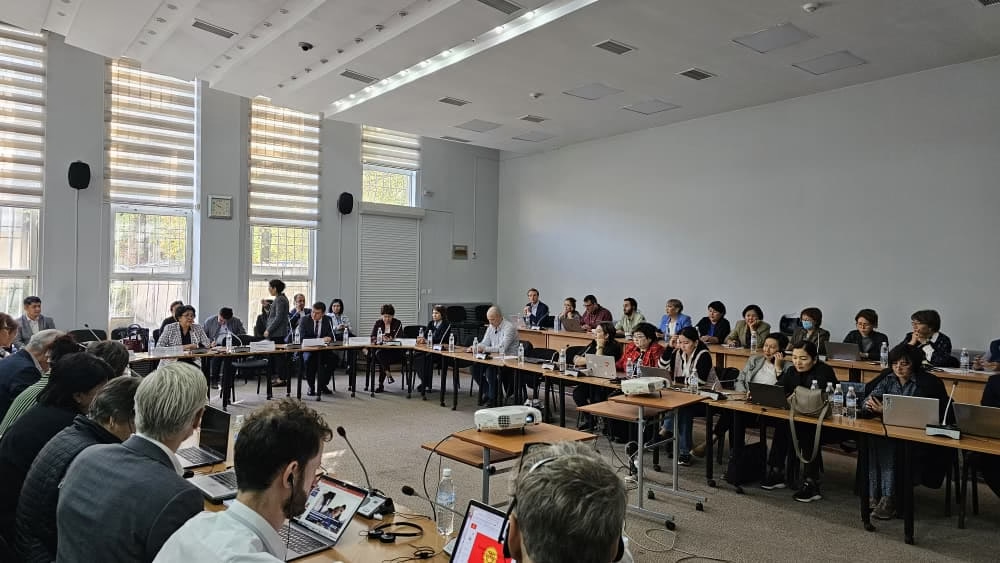
- Establishment of Technical Working Groups and oversight by the Health Policy Council
- Definition of explicit prioritisation criteria (including cost-effectiveness, burden of disease, equity and financial risk protection)
- Service-level costing using a comprehensive non-personnel cost model and costing of services outside of the package (to inform tariffs)
- Fiscal space analysis identifying USD 19 per capita in reallocatable funding
- Development of policy scenarios to illustrate coverage–cost trade-offs
- Implementation support of the benefits package and measurement of facility ‘readiness’ for the implementation
Our Approach: The EDP Framework in Action
We utilized the Evidence-Informed Deliberative Processes (EDPs) framework as our overarching approach, systematically operationalizing its core components to structure priority setting, ensure transparency, and maximize process legitimacy.
1. Governance & Institutional Framework
EDPs require a legitimate, transparent governance structure to oversee the priority-setting process and ensure institutional ownership.
- Multilateral Oversight: Established specialized Technical Working Groups (TWGs) to drive the technical process, with centralized oversight managed by the Health Policy Council.
- Standardized Architecture: Pioneered the first system-wide application of the WHO UHC Compendium (UHCC) to standardize service definitions across the entire health system.
2. Explicit Decision Criteria
A fundamental step in the EDP process is defining explicit, multi-dimensional criteria to guide choices beyond just clinical efficacy.
- Multi-Criteria Framework: Grounded all deliberations in clear, explicit decision criteria, including cost-effectiveness, burden of disease, equity, and financial risk protection.
3. Rigorous Evidence Generation
EDPs rely on the best available local and global data to inform stakeholders during deliberation.
- Comprehensive Service Mapping: Mapped existing and potential services into a robust, comprehensive inventory of 424 distinct interventions.
- Advanced Service Costing: Developed a comprehensive non-personnel cost model for service-level costing, extending the analysis to services outside the package to inform future tariff structures.
4. Deliberative Appraisal & Implementation Support
The final stage translates evidence through a structured deliberative lens to match operational realities and map out future deployment.
- Policy Scenario Modeling: Developed advanced policy scenarios to visually illustrate coverage–cost trade-offs, allowing decision-makers to navigate real-world fiscal constraints.
- Fiscal Space Analysis: Executed explicit fiscal space analysis, successfully identifying USD 19 per capita in reallocatable funding.
- Operational Readiness: Provided direct implementation support for the newly designed benefits package, systematically measuring facility “readiness” to ensure seamless deployment.
Outcomes
From 424 evaluated services, approximately 186 were classified as high priority. However, available fiscal space could finance only 66 services under a fully public funding model. Scenario modelling showed:
- Universal public coverage of 186 services would require USD 53.76 per capita
- Budget-constrained coverage of 66 services would cost USD 21.16 per capita
- A mixed public–private financing model could retain 186 services at USD 47.74 per capita
Key lessons include:
- Explicit service definitions are essential for coherent benefit design
- Comprehensive costing fundamentally shapes prioritisation outcomes
- Fiscal dialogue is as important as technical appraisal
- Large gaps between ambition and fiscal capacity require political decision-making beyond technical analysis
Kyrgyzstan demonstrates that comprehensive benefits package redesign is feasible when governance, costing and structured deliberation are integrated into one coherent process.
Related Publications & Reports
- Surgey G, Abou Jaoude GJ, Isaeva B, Zhetibaeva S, Kak M, Turgunbaeva J, Haghparast-Bidgoli H, Oskombaeva K, Baltussen RMPM. From Implicit to Explicit: An Evidence-Informed Deliberative Process for Health Benefits Package Revision Using the WHO UHC Compendium in Kyrgyzstan. BMJ Global Health. 2026;11:e024777. doi:10.1136/bmjgh-2026-024777.
- Abou Jaoude GJ, Nederpelt C, Zhetibaeva S, Surgey G, Kamali Sadeghian P, Misra N, Aidyldaeva E, Atakulov M, Orozaliev E, Neelsen S, Vermeersch C, Kambaralieva B, Skordis J, Palmer T, Baltussen R, Isaeva B, Haghparast-Bidgoli H. Costing Health Benefit Packages Using the WHO UHC Compendium: A Proof-of-Concept Study in Kyrgyzstan. International Journal of Health Policy and Management. 2026;15:9333. doi:10.34172/ijhpm.9333.