


Overview
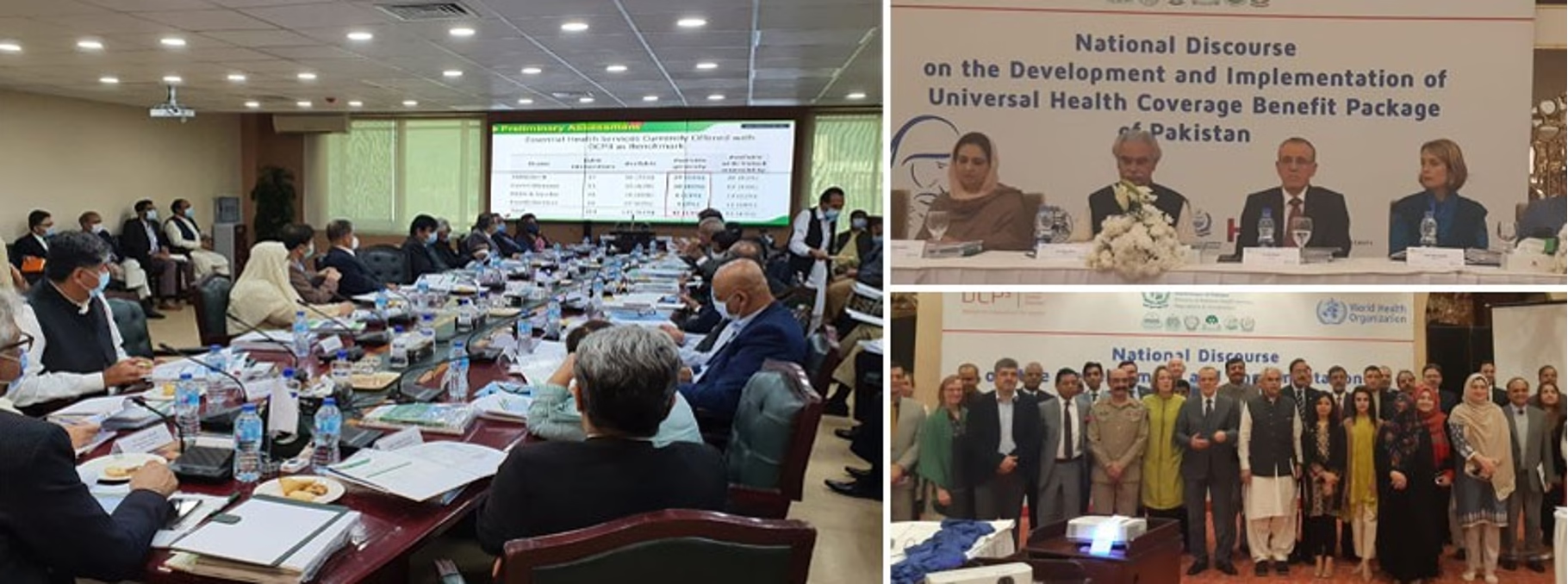
Pakistan developed its first national Essential Package of Health Services (EPHS) as a central step toward Universal Health Coverage. The process was led by the Ministry of National Health Services and implemented using an Evidence-Informed Deliberative Process (EDP) developed and operationalised by our team to support transparent and systematic prioritisation.
The resulting EPHS defines a fiscally grounded package of 117 district-level interventions, with phased implementation based on available fiscal space. The process combined technical analysis, stakeholder deliberation and explicit trade-offs across coverage, services and financial protection dimensions.
Context & Objectives
Pakistan, a lower-middle-income country with a decentralised health system, faces significant gaps in access to essential services, particularly in non-communicable diseases and health service access. Public health expenditure is limited, and out-of-pocket spending remains high.
In 2018, the government initiated development of a national EPHS drawing on the Disease Control Priorities 3 (DCP3) evidence base. The objective was to:
- Develop an evidence-informed and affordable essential package
- Institutionalise a structured priority setting process
- Align package design with fiscal realities
- Support phased implementation toward UHC
A dedicated governance structure was established, including Technical Working Groups (TWGs), a National Advisory Committee (NAC), and a Steering Committee under ministerial leadership.
Approach & Methods Used
- Evidence-Informed Deliberative Processes (EDPs) to structure priority setting and enhance legitimacy
- Installation of formal advisory committees (150+ stakeholders across TWGs and NAC)
- Explicit decision criteria: cost-effectiveness, avoidable burden of disease, equity, financial risk protection, budget impact, feasibility, socio-economic impact
- Systematic assessment of 170 candidate interventions
- Ingredients-based costing methodology for context-specific unit costs
- Deliberative appraisal separating unconstrained prioritisation from fiscal-constrained decision-making
- Explicit fiscal space analysis to define an Immediate Implementation Package
Outcomes
The final EPHS includes:
- 117 district-level interventions (US$ 29.7 per capita for full package)
- An Immediate Implementation Package of 88 interventions (US$ 12.98 per capita) aligned with fiscal constraints
- Additional prioritisation of tertiary-level services
Key lessons:
- Structured deliberation enhances perceived legitimacy of decisions
- Fiscal space analysis is essential for realistic package design
- Broad stakeholder engagement is feasible but requires strong facilitation
- Institutionalisation beyond package design remains the critical next step
- Transition from design to implementation requires continued capacity building and financing reform
The national EPHS guided subsequent provincial adaptation processes.
Related Publications & Reports
- Baltussen R, Jansen M, Akhtar SS, Bijlmakers L, Torres-Rueda S, Khalid M, Raza W, Huda M, Surgey G, Zulfiqar W, Vassall A, Zaidi R, Siddiqi S, Alwan A. The Use of Evidence-Informed Deliberative Processes for Designing the Essential Package of Health Services in Pakistan. International Journal of Health Policy and Management. 2024;13:8004. doi:10.34172/ijhpm.2023.8004.
- Alwan A, Siddiqi S, Safi M, Zaidi R, Khalid M, Baltussen R, Gudumac I, Huda M, Jansen M, Raza W, Torres-Rueda S, Zulfiqar W, Vassall A. Addressing the UHC Challenge Using the Disease Control Priorities 3 Approach: Lessons Learned and an Overview of the Pakistan Experience. International Journal of Health Policy and Management. 2024;13:8003. doi:10.34172/ijhpm.2023.8003.