
A joint research and capacity strengthening programme by Radboudumc and University College London

Category: profile

  • Anna Socha

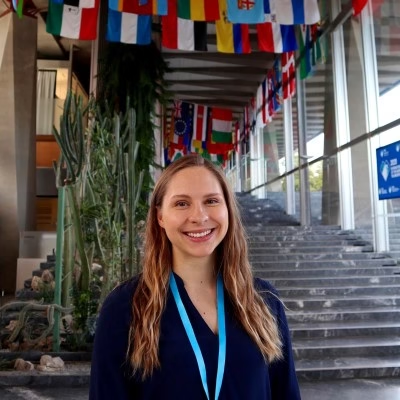
    Anna Socha

    I am an inquisitive and ambitious young professional in global health with a passion for interdisciplinary research and collaboration. I love deep dives into complex global issues and working to advance health and gender equity.

    With many years of global health education and practicums, I have developed a solid foundation across a number of academic disciplines in social sciences and health sciences. My research skills are largely in literature & systematic reviews, qualitative research, and community-based research; however, my knowledge from various research methods courses (and my growth mindset) provide me with a strong footing for jumping into new areas.

    I am particularly fascinated by health system governance, particularly participatory, equitable, and evidence-informed policy and decision making processes. Topics I am passionate about include, but are certainly not limited to: gender equity and reproductive justice, migrant health, Indigenous health, and investigating the social, political, economic and commercial determinants of any health issue.

    In my personal time, I love (attempting) to keep up with topics in social justice and politics, and staying active!


    CV & Links

  • Jolene Skordis

    Jolene Skordis

    Jolene Skordis is a Professor of Economics, specialising in Health and Development. She is Vice-Dean (International and Advancement) for UCL’s Faculty of Population Health Sciences, Chair of the European Global Health Research Institutes Network, a Senior Research Fellow at the Institute for the Future of Work, a Fellow of the Royal Society for Public Health and a Fellow of the Royal Economic Society. She is a regular advisor to the World Bank and the Global Fund. Her research spans the evaluation of complex public health interventions, fiscal space for sustainable and scalable health service delivery, anti-poverty programmes, gender empowerment, social networks, equity and the impact of technology on the future of work and wellness.  Her work has directly influenced government policy in a range of countries.

    CV & Links

  • Gerard Joseph Abou Jaoude

    Gerard Joseph Abou Jaoude

    Gerard Abou Jaoude is Deputy Director of the UCL Centre for Global Health Economics and a Senior Research Fellow at the UCL Institute for Global Health. He specialises in health financing, economic evaluation, and the development and application of resource optimisation and costing tools to inform priority setting and health benefit package design.

    Gerard has worked extensively with Ministries of Health and international partners, including the World Bank, WHO, and the Global Fund, to support evidence-based decision-making. His work focuses on costing health systems and programmes, modelling health impacts, and applying allocative efficiency approaches to improve the use of limited resources.

    He has led and contributed to health system-wide and programme-specific analyses across a wide range of areas, including HIV, TB, and non-communicable diseases, and has supported health financing reforms and benefit package design in countries across Eastern Europe, Sub-Saharan Africa, the Middle East, South America, and South Asia.

    CV & Links

    CV

  • Hassan Haghparast-Bidgoli

    Hassan Haghparast-Bidgoli

    Hassan is Director of the UCL Centre for Global Health Economics, with over 20 years of experience in health economics, health financing, and health technology assessment (HTA). His work focuses on improving health system efficiency and supporting evidence-based decision-making.

    Hassan has led economic evaluations and allocative efficiency analyses of HIV, TB, and broader health programmes across Central Asia, Eastern Europe, South Asia, Sub-Saharan Africa, and Latin America. He works closely with governments and international partners, including the World Bank and WHO, to optimise resource allocation and strengthen national health policies.

    More recently, he has played a key role in the design and costing of national health benefit packages in countries such as Afghanistan, Zimbabwe, Liberia, and Kyrgyzstan, supporting progress towards universal health coverage.

    CV & Links

  • Anna Prakash

    Anna Prakash

    Anna Prakash is a Health Technology Assessment (HTA) researcher and health policy professional. With a background in supporting low- and middle-income countries (LMICs) to institutionalize HTA for evidence-based healthcare decision-making, she previously worked with the Health Intervention and Technology Assessment Program (HITAP) in Thailand. Annapoorna holds a Master of Public Health from King’s College London, where she focused on advanced statistics and epidemiology, and has research experience in maternal and child health from the London School of Hygiene & Tropical Medicine. She is currently pursuing her PhD at Radboud University Medical Center in the Netherlands, where her research focuses on developing an HTA framework for digital health technologies across their lifecycle.

    CV & Links

  • Leon Bijlmakers

    Leon Bijlmakers

    Leon’s expertise is in global health policy review and health systems strengthening. Having worked with global agencies, governments, academic institutions and national and international non-governmental organisations across the globe, he focuses on implementation research around health systems performance and responsiveness, including health benefit package revision, innovations and scaling of interventions in the context of scarcity.

    He served as principal investigator in two EU-funded research projects (COST-Africa, SURG-Africa); as co-investigator in the CDG/iDSI-led project Making explicit choices on the path to UHC: the JLN health benefits package revision guide; and as co-lead of three citizen consultation projects in the Netherlands. He is currently involved as principal investigator for multi-criteria decision analysis in the CAREFREE project (Creating A healthieR Environment for FutuRE patiEnts) led by Maastricht UMC. Since 2020 he serves as editor of the journal Tropical Medicine & International Health.

    CV & Links

    ResearchGate Profile

  • Charlie Nederpelt

    Charlie Nederpelt

    Charlie is a physician-scientist and health economist. He completed his PhD dissertation in Trauma Epidemiology jointly at Leiden and Harvard University, studying issues across trauma surgery, including mass transfusion, prevention of bleeding and thrombosis, and the application of artificial intelligence in triage. 

    Currently, he is fascinated by how societies prioritize (healthcare) spending, and researches how various stakeholders can generate and use information on healthcare cost and effects, especially with little data available.  He has worked on policy analysis and health system reform across Suriname, Kyrgyzstan, Kenya, and the Netherlands. His current work and research projects support decision-makers in Palestine, Indonesia and Timor-Leste.

    Besides academic research, he is also involved in developing software tools to process and present health evidence for population health management decisions.

    CV & Links

  • Cassie Nemzoff

    Cassie Nemzoff

    Cassie Nemzoff is a health economist with over a decade of experience working across Sub-Saharan Africa, Asia, Europe and the United States. Her work is focused on improving priority setting for health in low- and middle- income countries, including health benefits package design and economic evaluation. 

    She is a specialist in “adaptive” health technology assessment (aHTA) methods, which expedite evidence-informed policy making and improve the overall efficiency of priority setting systems. This is done by adjusting assessment methods for time, data, and capacity constraints while maintaining appropriate methodological rigour. Her current work is focused on further developing aHTA methods and evaluating the appropriateness and risks of using them. 

    Previously, Cassie worked for the Center for Global Development as part of the international Decision Support Initiative (iDSI) in London and Washington, DC, and the Clinton Health Access Initiative in Malawi. In both roles, she provided technical assistance to Ministries of Health and Finance to design and apply context-specific aHTA methods, prioritise health benefits packages, and conduct economic evaluations. Cassie started her research career at PwC’s Health Research Institute where she did research to inform the roll out of the US Affordable Care Act.

    CV & Links

    ResearchGate Profile

    Radboudumc Profile

  • Wija Oortwijn

    Wija Oortwijn

    Wija Oortwijn is a globally recognized leader in Health Technology Assessment. She has more than 30 years of international experience in strengthening health systems, institutionalization of HTA and evidence-informed decision making around the globe. Her  work is focused on supporting governments, global agencies and academic institutions to strengthen HTA capacity and advance value frameworks and deliberative processes that promote transparent and legitimate priority setting. 

    She has played key roles in major HTA collaborations, contributed to pioneering European HTA-initiatives and led the development of a HTA competency framework, as well as international guidance development for deliberative processes. She also served as President of HTAi, further shaping the global HTA agenda.

    She is the chair of the Insured Package Advice Committee of the National HTA agency in the Netherlands (Zorginstituut Nederland), and deputy editor of the International Journal of Technology Assessment in Health Care (IJTAHC).

    CV & Links

    ResearchGate Profile

    Radboudumc Profile

  • Gavin Surgey

    Gavin Surgey

    Gavin’s work focuses on the institutionalisation of health technology assessment and explicit health benefit package design in low- and middle-income countries. His research examines how evidence-informed deliberative processes can be applied to strengthen priority-setting systems and align national health benefit packages with population needs and fiscal realities.

    His work is applied across Sub-Saharan Africa, Central Asia, and Eastern Europe. Recently he has led the design of Kyrgyzstan’s State-Guaranteed Benefits Package with the WHO Universal Health Coverage Compendium as the foundational architecture for a benefits package revision – the first national application of this. He is currently supporting Tajikistan in a similar exercise. 

    In Ghana, he supported the Ministry of Health and National Health Insurance Authority in developing national HTA guidelines and establishing structured appraisal processes for reimbursement decisions. His broader work spans HTA institutionalisation in Kazakhstan, Moldova, Tanzania, and Cambodia, contributing to sustainable, equity-informed health system decision-making in pursuit of universal health coverage.

    CV & Links

    ResearchGate Profile

    Radboudumc Profile

  • Rob Baltussen

    Rob Baltussen

    Rob Baltussen is Professor of Health Economics at Radboudumc. He leads the Global Health Priorities programme, which focuses on health priority setting and the design and institutionalisation of national health benefit packages.

    His work centres on Evidence-Informed Deliberative Processes (EDPs) as a structured framework for organising difficult priority decisions. He studies how economic evidence, explicit decision criteria and stakeholder deliberation can be integrated within governance systems to strengthen transparency and accountability.

    With more than twenty years of experience in global health and health economics, he has advised governments and international organisations on embedding structured priority setting approaches within national policy frameworks. His research combines methodological development with applied policy engagement across diverse health system contexts.

    CV & Links

    ResearchGate Profile

    Radboudumc Profile